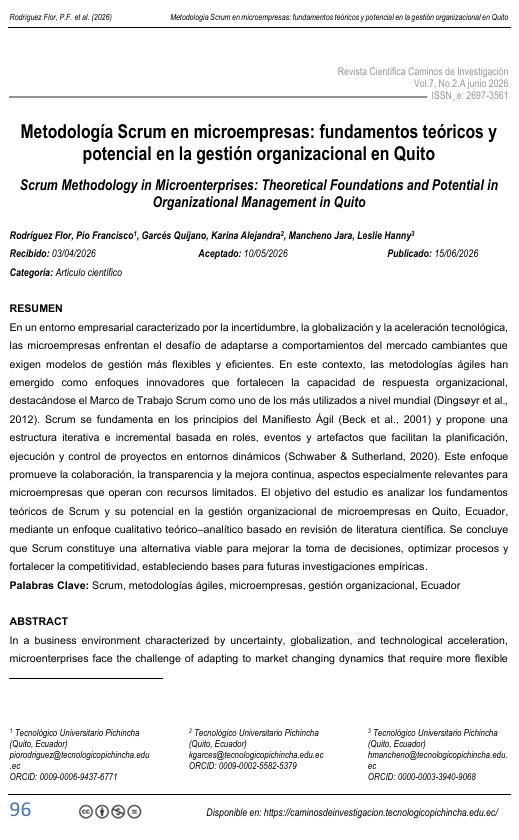
Metodología Scrum en microempresas: fundamentos teóricos y potencial en la gestión organizacional en Quito
Scrum Methodology in Microenterprises: Theoretical Foundations and Potential in Organizational Management in Quito
DOI:
https://doi.org/10.59773/ci.v7i2.A.146Palabras clave:
Scrum, metodologías ágiles, microempresas, gestión organizacional, EcuadorResumen
RESUMEN
En un entorno empresarial caracterizado por la incertidumbre, la globalización y la aceleración tecnológica, las microempresas enfrentan el desafío de adaptarse a comportamientos del mercado cambiantes que exigen modelos de gestión más flexibles y eficientes. En este contexto, las metodologías ágiles han emergido como enfoques innovadores que fortalecen la capacidad de respuesta organizacional, destacándose el Marco de Trabajo Scrum como uno de los más utilizados a nivel mundial (Dingsøyr et al., 2012). Scrum se fundamenta en los principios del Manifiesto Ágil (Beck et al., 2001) y propone una estructura iterativa e incremental basada en roles, eventos y artefactos que facilitan la planificación, ejecución y control de proyectos en entornos dinámicos (Schwaber & Sutherland, 2020). Este enfoque promueve la colaboración, la transparencia y la mejora continua, aspectos especialmente relevantes para microempresas que operan con recursos limitados. El objetivo del estudio es analizar los fundamentos teóricos de Scrum y su potencial en la gestión organizacional de microempresas en Quito, Ecuador, mediante un enfoque cualitativo teórico–analítico basado en revisión de literatura científica. Se concluye que Scrum constituye una alternativa viable para mejorar la toma de decisiones, optimizar procesos y fortalecer la competitividad, estableciendo bases para futuras investigaciones empíricas.
Palabras Clave: Scrum, metodologías ágiles, microempresas, gestión organizacional, Ecuador
ABSTRACT
In a business environment characterized by uncertainty, globalization, and technological acceleration, microenterprises face the challenge of adapting to market changing dynamics that require more flexible and efficient management models. In this context, agile methodologies have emerged as innovative approaches that enhance organizational responsiveness, with the Scrum framework standing out as one of the most widely used worldwide (Dingsøyr et al., 2012). Scrum is grounded in the principles of the Agile Manifesto (Beck et al., 2001) and proposes an iterative and incremental structure based on roles, events, and artifacts that facilitate planning, execution, and control in dynamic environments (Schwaber & Sutherland, 2020). This approach promotes collaboration, transparency, and continuous improvement, which are particularly relevant for microenterprises operating with limited resources. The objective of this study is to analyze the theoretical foundations of Scrum and its potential in the organizational management of microenterprises in Quito, Ecuador, using a qualitative theoretical–analytical approach based on literature review. The findings indicate that Scrum is a viable alternative for improving decision-making, optimizing processes, and strengthening competitiveness, providing a basis for future empirical research.
Keywords: Scrum; agile methodologies; microenterprises; organizational management; Ecuador
Citas
Beck, K., Beedle, M., Van Bennekum, A., Cockburn, A., Cunningham, W., Fowler, M., Grenning, J., Highsmith, J., Hunt, A., Jeffries, R., Kern, J., Marick, B., Martin, R. C., Mellor, S., Schwaber, K., Sutherland, J., & Thomas, D. (2001). Manifesto for agile software development. https://agilemanifesto.org
Denning, S. (2016). The age of agile: How smart companies are transforming the way work gets done. AMACOM.
Dingsøyr, T., Nerur, S., Balijepally, V., & Moe, N. B. (2012). A decade of agile methodologies: Towards explaining agile software development. Journal of Systems and Software, 85(6), 1213–1221. https://doi.org/10.1016/j.jss.2012.02.033
Highsmith, J. (2002). Agile software development ecosystems. Addison-Wesley.
Nonaka, I., & Takeuchi, H. (1986). The new new product development game. Harvard Business Review, 64(1), 137–146.
Petersen, K., & Wohlin, C. (2010). The effect of moving from a plan-driven to an agile development approach with agile practices: An industrial case study. Empirical Software Engineering, 15(6), 654–693. https://doi.org/10.1007/s10664-010-9136-6
Rigby, D., Sutherland, J., & Takeuchi, H. (2016). Embracing agile. Harvard Business Review, 94(5), 40–50.
Schwaber, K., & Sutherland, J. (2020). The Scrum Guide: The definitive guide to Scrum: The rules of the game. Scrum.org. https://scrumguides.org
Descargas
Publicado
Cómo citar
Número
Sección
Categorías
Licencia

Esta obra está bajo una licencia internacional Creative Commons Atribución-NoComercial-CompartirIgual 4.0.