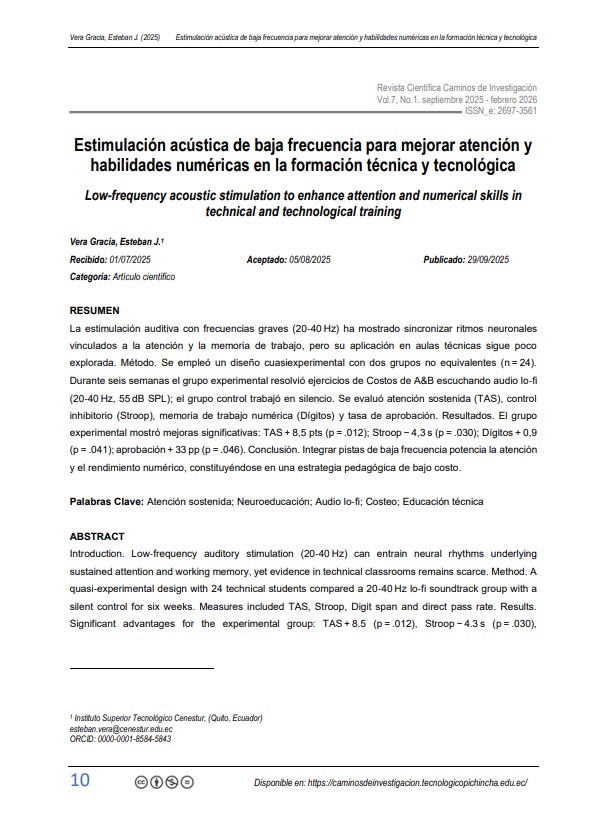
Estimulación acústica de baja frecuencia para mejorar atención y habilidades numéricas en la formación técnica y tecnológica
Low-frequency acoustic stimulation to enhance attention and numerical skills in technical and technological training
DOI:
https://doi.org/10.59773/ci.v7i1.111Palabras clave:
Atención sostenida, Neuroeducación, Audio Lo-Fi, Costeo, Educación técnicaResumen
RESUMEN
La estimulación auditiva con frecuencias graves (20‑40 Hz) ha mostrado sincronizar ritmos neuronales vinculados a la atención y la memoria de trabajo, pero su aplicación en aulas técnicas sigue poco explorada. Método. Se empleó un diseño cuasiexperimental con dos grupos no equivalentes (n = 24). Durante seis semanas el grupo experimental resolvió ejercicios de Costos de A&B escuchando audio lo‑fi (20‑40 Hz, 55 dB SPL); el grupo control trabajó en silencio. Se evaluó atención sostenida (TAS), control inhibitorio (Stroop), memoria de trabajo numérica (Dígitos) y tasa de aprobación. Resultados. El grupo experimental mostró mejoras significativas: TAS + 8,5 pts (p = .012); Stroop − 4,3 s (p = .030); Dígitos + 0,9 (p = .041); aprobación + 33 pp (p = .046). Conclusión. Integrar pistas de baja frecuencia potencia la atención y el rendimiento numérico, constituyéndose en una estrategia pedagógica de bajo costo.
ABSTRACT
Introduction. Low‑frequency auditory stimulation (20‑40 Hz) can entrain neural rhythms underlying sustained attention and working memory, yet evidence in technical classrooms remains scarce. Method. A quasi‑experimental design with 24 technical students compared a 20‑40 Hz lo‑fi soundtrack group with a silent control for six weeks. Measures included TAS, Stroop, Digit span and direct pass rate. Results. Significant advantages for the experimental group: TAS + 8.5 (p = .012), Stroop − 4.3 s (p = .030), Digits + 0.9 (p = .041), pass rate + 33 pp (p = .046). Conclusion. Systematic low‑frequency soundtracks enhance attention and academic performance in numeracy‑intensive courses.
Citas
Chaieb, L., Wilpert, E., Reber, T., & Fell, J. (2015). Auditory beat stimulation and its effects on cognition and mood states. Frontiers in Psychiatry, 6, Article 70. https://doi.org/10.3389/fpsyt.2015.00070
Davis, G., & Martinez, E. (2023). The science behind lo‑fi beats: Implications for study habits. The Oxford Scientist. https://oxsci.org/the-science-behind-lo-fi-beats/
García-Argibay, M., Santed, M. A., & Riba, J. (2019). Efficacy of binaural auditory beats in cognition, anxiety, and pain perception: A meta-analysis. Psychological Research, 83(2), 357–372. https://doi.org/10.1007/s00426-018-1066-8
Ginns, P., Muscat, K., & Naylor, R. (2023). Rest breaks aid directed attention and learning. Educational and Developmental Psychologist, 40(2), 141–150. https://doi.org/10.1080/20590776.2023.2225700
Ingendoh, R., & Posny, E. (2023). Binaural beats to entrain the brain? A systematic review of the effects of binaural beat stimulation on brain oscillatory activity. PLOS ONE, 18(5), e0286023. https://doi.org/10.1371/journal.pone.0286023
Kantor, J., Vilímek, Z., Vítězník, M., Smrčka, P., Campbell, E., Bucharová, M., … Kantorová, L. (2022). Effect of low-frequency sound vibration on acute stress response. Frontiers in Psychology, 13, 980756. https://doi.org/10.3389/fpsyg.2022.980756
Lakatos, P., Yamawaki, N., Cruse, D., O’Connell, R. G., & Schroeder, C. E. (2019). A new unifying account of the roles of neuronal entrainment. Current Biology, 29(18), R890–R905. https://doi.org/10.1016/j.cub.2019.07.075
Manippa, V., Filardi, M., Vilella, D., Logroscino, G., & Rivolta, D. (2024). Gamma (60 Hz) auditory stimulation improves intrusions but not recall and working memory in healthy adults. Behavioural Brain Research, 456, 114703. https://doi.org/10.1016/j.bbr.2023.114703
Peng, L., Li, J., Liu, Z., Zhao, S., & Wei, J. (2024). Effect of low-frequency noise exposure on cognitive function: A systematic review and meta-analysis. BMC Public Health, 24, 17593. https://doi.org/10.1186/s12889-023-17593-5
Ramzi, H. (2023). Lo‑fi: Modern concentration. Open Journal of Medical Psychology, 12(4), 239–258. https://doi.org/10.4236/ojmp.2023.124014
Riccio, C., Reynolds, C., & Lowe, P.. (2002). CPT-3: Continuous Performance Test – Third Edition. Technical manual. Multi-Health Systems
Stroop, J. (1935). Studies of interference in serial verbal reactions. Journal of Experimental Psychology, 18(6), 643-662. https://doi.org/10.1037/h0054651
Wechsler, D. (2008). WAIS-IV: Wechsler Adult Intelligence Scale – Fourth Edition. Technical and interpretive manual. Pearson.
Xu, M., Zhang, L., & Chen, H. (2024). Effects of vibroacoustic sound massage on psychological, physiological, and cognitive stress. Sensors, 24(18), 5924. https://doi.org/10.3390/s24185924.
Descargas
Publicado
Cómo citar
Número
Sección
Categorías
Licencia

Esta obra está bajo una licencia internacional Creative Commons Atribución-NoComercial-CompartirIgual 4.0.